Roofers Adel · LS16 Price Fixed In Writing Free Quotes & Drone Surveys Emergency Callouts, 7 Days Fully Insured · £5m Cover Roofers Adel · LS16 Price Fixed In Writing Free Quotes & Drone Surveys Emergency Callouts, 7 Days
Roofers · Adel LS16
Roofers in Adel
Chimney stacks, stone and slate roofs, flat roofs and tiled estate homes across Adel, from Church Lane and Long Causeway to the streets off Otley Road. Free survey, a fixed price in writing, and emergency callouts 7 days a week from our base in Kirkstall.
Conservation areaPartlyAdel-St John’s CA, Leeds City Council
Typical homes1930s arts & crafts houses, semis, post-war estates
Most common jobsChimneys, stone slate, flat roofs
From our base2.8 milesKirkstall, LS5
A suburb built decade by decade
Adel sits on high ground north of Leeds, just east of Otley Road (A660), with Green Belt farmland to its north. Leeds City Council’s conservation appraisal puts the historic core around St John’s Church at roughly 120 metres above sea level, between the Aire and Wharfe valleys, and describes the rest of Adel as suburban development from the 1930s to the 1980s. The Adel Neighbourhood Design Statement sums it up neatly: each decade favoured its own style, so Adel has become a history of 20th-century suburban house building. The 2001 census figures it quotes show detached houses far outnumbering everything else (1,311 detached, 574 semis, 186 terraced and 540 flats). That mix means roofs of very different kinds within a short walk, from gritstone cottages with stone slate to flat-roofed 1930s modernist houses and tiled 1970s estates. Each one starts with a free survey and a fixed quote in writing.
Tall external stacks and chimney repairs
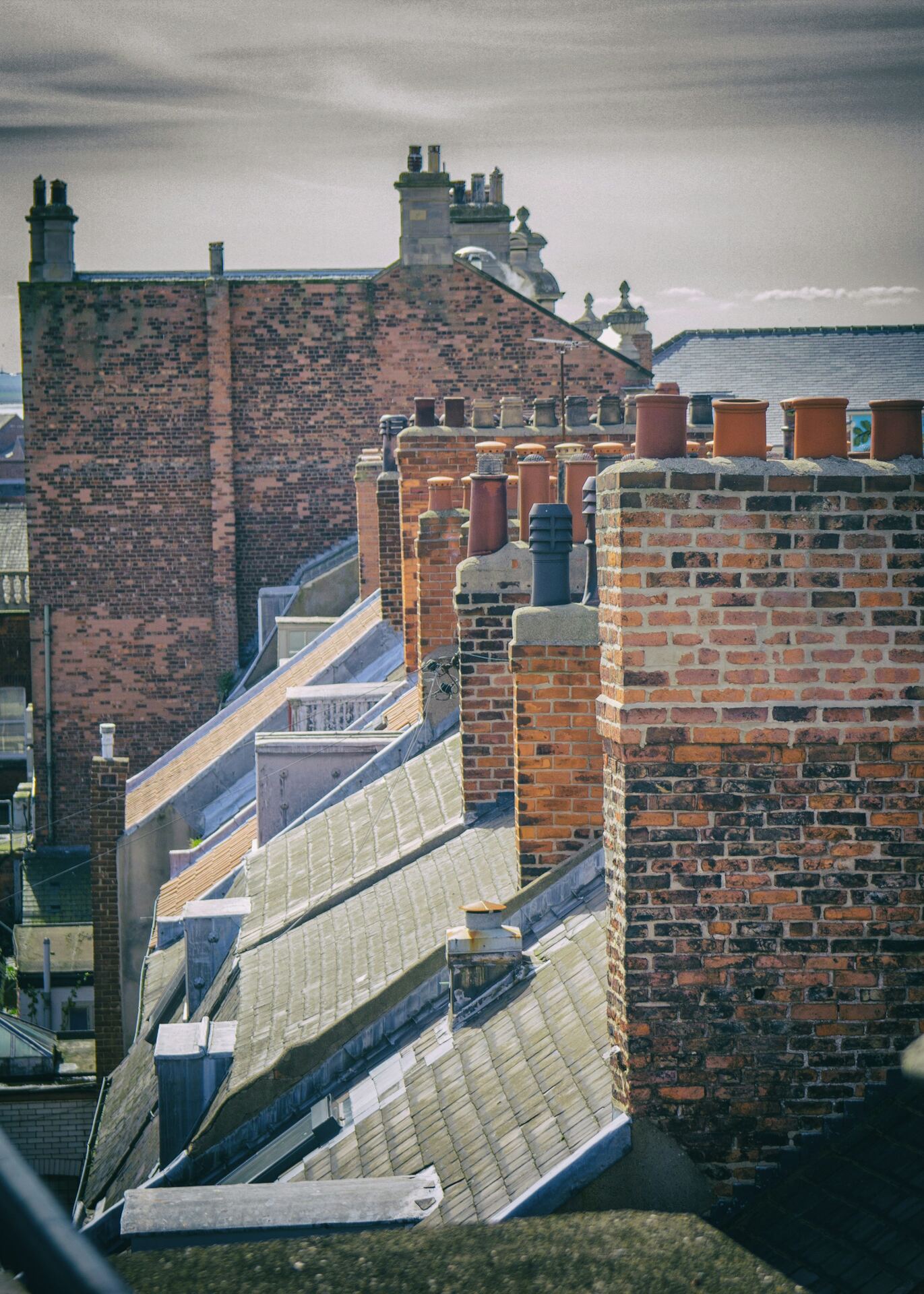
Chimneys come up again and again in the Design Statement’s descriptions of Adel. Old Adel’s gritstone buildings have tall external stacks, and the 1930s houses around Adel Lane and Long Causeway are noted for tall chimneys and external stacks too, with the stacks on semis rising from the middle partition wall. An external stack built up the outside of a gable is exposed on three sides, so it weathers faster than one buried in the roof. Signs worth acting on:
Open or sandy joints — mortar eroded from the brick or stone. Stone stacks are repointed in a lime mortar, which lets the masonry dry out; brick stacks get a mortar matched to the brick.
Damp on a chimney breast or gable wall — often failed lead where the stack meets the roof, or water soaking down through a stack that has lost its pointing.
Crumbling flaunching or a loose pot — the mortar bed holding the pots breaks up with frost. A flue that is no longer used can be capped with a vented cap so it stays dry and ventilated.
A stack out of plumb — a leaning stack is taken down to sound masonry and rebuilt, reusing good original stone or brick.
Guide prices: repointing from £350, lead flashing from £450, a partial rebuild from £600, a full rebuild from £1,500, and scaffolding from £400. What you actually pay depends on access and on the condition we find, and it’s fixed in writing after a free survey; where a stack is hard to see from the ground, a free drone survey shows us its top before anyone climbs. See our chimney repair costs guide and chimney repairs page.
Adel-St John’s Conservation Area
Adel’s conservation area is small and centred on the Church of St John the Baptist, built around 1150 and listed Grade I by Historic England. Its official list entry describes coursed squared gritstone walls under stone slate roofs, with the west gable and bellcote rebuilt in 1838–39 by R. D. Chantrell. The area was first designated on 17 July 1974, and Leeds City Council reviewed and redesignated it on 2 November 2009, when it approved the Adel-St John’s Conservation Area Appraisal and Management Plan. Around the church are the former Rectory of 1652 (now Ashling House and Aisling Cottage), the listed Parish Hall built as stables and a coach house about 1766, and scattered farmhouses and cottages along Church Lane, Back Church Lane and Long Causeway.
The appraisal records regularly coursed sandstone or millstone grit walls with roofs of natural Welsh slate or stone slate, and pitched roofs usually topped with chimney stacks and clay pots. It names “poor choice of materials on the replacement of historic features” as one of the area’s issues.
Planning & permissions
Roof work inside the boundary
Keep the traditional covering — the appraisal lists pitched roofs in traditional materials, with their chimney stacks, among the key ways to keep Adel’s character. Stone slate is repaired in stone slate and Welsh slate in Welsh slate; a switch to concrete tiles would run against that.
Chimneys stay — for the same reason, a stack is normally repaired or rebuilt rather than removed. Ask Leeds planning before taking one down.
Dormers need permission — the appraisal notes that in a conservation area rear dormer windows are no longer permitted development.
Listed buildings — any change to the roof of the church, the Parish Hall or another listed building needs listed building consent, and repairs should follow the original materials.
Trees — much of the conservation area is already covered by a Tree Preservation Order. Elsewhere in it, any tree with a trunk over 7.5cm across at 1.5 metres high is protected, and work needs six weeks’ notice to the council.
At the survey we’ll flag anything likely to need consent. Boundary maps are on Leeds City Council’s conservation area pages.
Adel’s homes, roof by roof
Old Adel stone buildings
Gritstone farmhouses, cottages and converted mill and farm buildings around the church, Long Causeway and Adel Mill. Two or three storeys with tall external stacks, mostly inside or near the conservation area.
Stone slate or Welsh slate · gritstone stacks · clay pots
1930s houses on Adel Lane
Large semis and detached houses around Adel Lane and Long Causeway, a mix of arts and crafts styles and 1930s modernism. White Lodge, designed in 1935 by John Clifford Procter, is a flat-roofed house built as a series of cubes.
The Redesdales off New Adel Lane were built in the late 1930s by the Bradford Property Trust in red brick and white render. The Kingsleys and Gainsboroughs off Holt Lane are 1950s cottage-style semis.
Red or grey tiles · brick stacks
1970s–90s estates
Small developments either side of Sir George Martin Drive and Long Causeway, mostly detached houses with integral garages, each in the style of its decade. Typical work is ridge, verge, valley and fascia repairs.
Concrete or clay tiles · uPVC fascias
Flat roofs, from 1930s modernism to garage extensions
The Design Statement picks out flat roofs as part of the 1930s modernist houses around Adel Lane, alongside curved metal windows and balconies. On a house like that the flat roof is part of the design, and replacing a tired covering with a modern membrane keeps the original lines. The Statement also records the 1972 bungalows on Stairfoot Walk, which were built with flat roofs that later had to be replaced with sloping ones because of the weather. Most flat roofs in Adel today are over garages, dormers and rear extensions on the post-war estates. Old felt fails at upstands and edge trims first, and standing water makes it worse. We repair where the deck is sound and re-cover where it isn’t; see flat roofing for the options.
Storm damage and fallen branches
Adel stands on high ground, so its more open streets take the full force of strong winds, and the appraisal notes mature trees standing very close to buildings, most of all around the churchyard and York Gate Garden. After a storm, check for slipped slates or tiles, lifted ridges, a loose chimney pot and damage from branches. We take emergency callouts 7 days a week: first we make the roof safe and watertight, then we give you a fixed written quote for the permanent repair. More on our emergency roof repairs page.
From Kirkstall (LS5) we cover Adel streets including Church Lane, Back Church Lane, Long Causeway, Adel Lane, Otley Road, New Adel Lane, Holt Lane, Holt Close, St Helen’s Lane, Sir George Martin Drive, Wayland Drive, Dunstarn Lane, Dunstarn Drive, Eastmoor Lane, Tile Lane, Kingsley Avenue, Gainsborough Avenue, Redesdale Gardens, Rothbury Gardens, Stairfoot Close, Mulberry Avenue, Adel Park Gardens and the surrounding streets of LS16.
Probably not, unless it’s close to the church. The conservation area is small, covering St John the Baptist’s Church, the old Rectory, the Parish Hall and the historic buildings along Church Lane, Back Church Lane and Long Causeway. Most of Adel’s 20th-century housing is outside it. Leeds City Council publishes the boundary map on its conservation area pages.
Usually not for a like-for-like re-roof. The Adel Neighbourhood Design Statement notes that outside listed buildings and conservation areas, householders don’t normally need permission to change roof coverings. Some older planning permissions removed those rights, so check with Leeds City Council if your house was built under one with conditions. Dormers and other roof extensions have their own rules.
It can be done, but it changes the shape of the house, so it is likely to need planning permission, and on a modernist design it can spoil the look. Re-covering the flat roof with a modern membrane is usually simpler. We’ll set out both options in a written quote after a free survey.
Our starting prices are £350 for repointing, £450 for lead flashing, £600 for a partial rebuild and £1,500 for a full rebuild, with scaffolding from £400. Tall external stacks and awkward access change the figure, so the final price is fixed in writing after a free survey. The figures are explained in our chimney repair costs guide.
Tall chimney, tired flat roof or storm damage in Adel?
A free survey, a fixed written price and a 10-year workmanship guarantee on major work.