Roofers Hyde Park · LS6 Price Fixed In Writing Free Quotes & Drone Surveys Emergency Callouts, 7 Days Fully Insured · £5m Cover Roofers Hyde Park · LS6 Price Fixed In Writing Free Quotes & Drone Surveys Emergency Callouts, 7 Days
Roofers · Hyde Park LS6
Roofers in Hyde Park
Slate terrace roofs, attic dormers, chimney stacks and gutters across Hyde Park, from Ash Grove and Kensington Terrace to Hyde Park Corner and the Brudenells. Clear written quotes for owners, landlords and agents, and emergency callouts 7 days a week.
Conservation areaPartlyHeadingley Hill, Hyde Park & Woodhouse Moor CA
Typical homesVictorian brick terraces, some back-to-backs, stone villas
Most common jobsSlate roofs, dormers, chimneys, gutters
From our base1.8 milesKirkstall, LS5
Terraces between the Moor and Victoria Road
Hyde Park was built up from 1850 onwards on land next to Woodhouse Moor, the first public park in Leeds. Leeds City Council’s conservation area appraisal says a local landowner gave it the name, along with Regent’s Park, after a visit to London, to make the area sound grander. Compared with the stone villas on Headingley Hill, the plots were smaller and the rents lower, and most of the houses are long red-brick terraces. The appraisal notes that even these modest terraces have stone lintels and sills, and detail in their bargeboards, dormers and eaves.
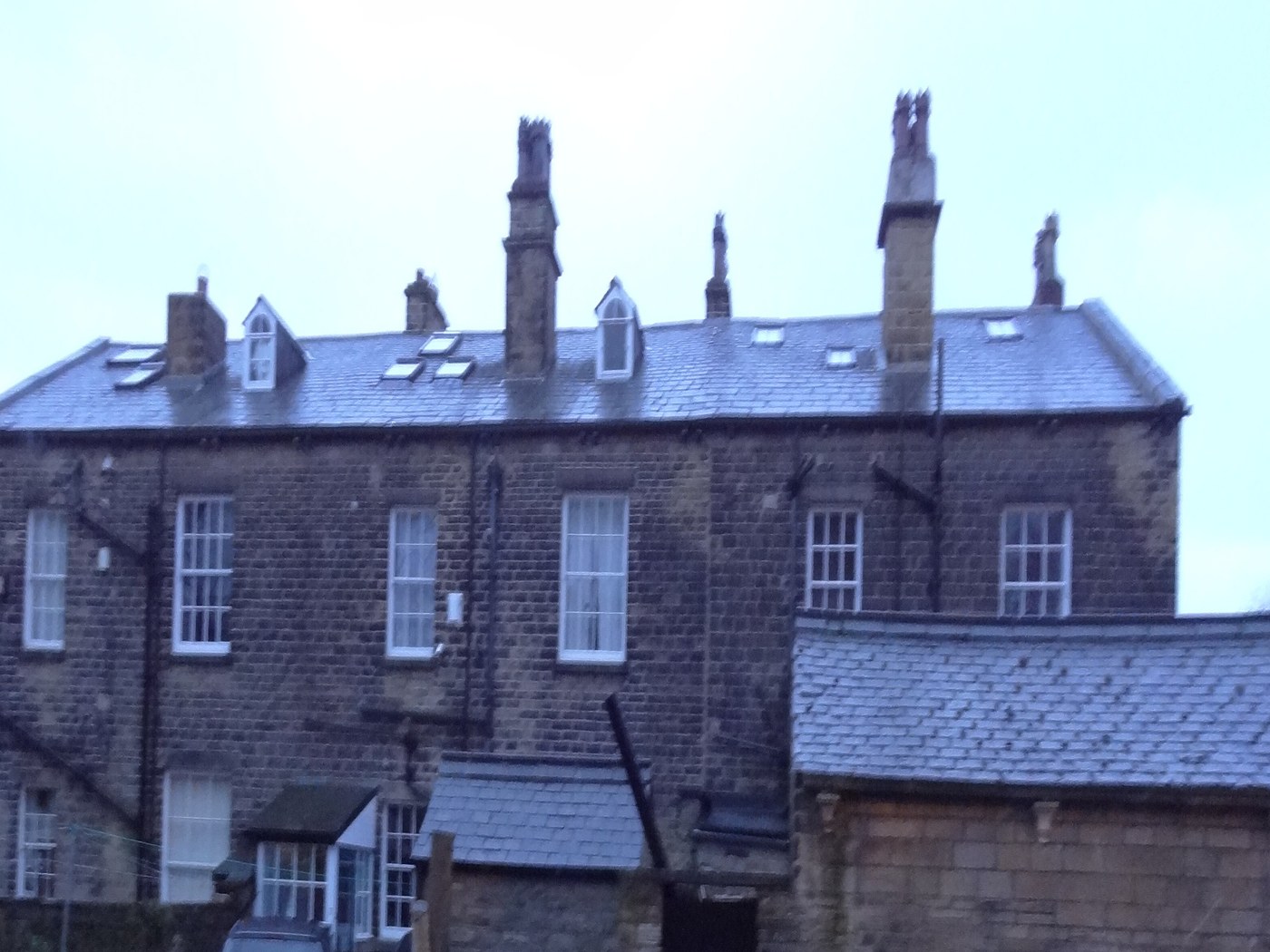
Most of the work on these roofs is about keeping long, shared slate roofs in good order: slipped slates, failing dormers, chimneys shared between two houses and gutters that run the length of a row. We survey for free and give you a fixed price in writing first.
Hyde Park and its conservation area
Hyde Park Corner, the terraces around St Augustine’s Church and the streets between Headingley Lane and Victoria Road were added to the old Headingley Conservation Area in 1984. In 2012 they became part of the new Headingley Hill, Hyde Park and Woodhouse Moor Conservation Area. The council’s appraisal and management plan describes Hyde Park as a mainly terraced area around Hyde Park Corner. Its terraces include Ash Grove (the longest row), Hyde Park Road, Kensington Terrace, Hyde Park Terrace and Regent Park Terrace, and the boundary now also takes in the terrace between Brudenell Grove and Queens Road.
The appraisal is direct about roofs. It says the roofscape of some terraces has lost its coherence through “unsympathetic modern dormers”, and illustrates this with Hyde Park Terrace. It also names the replacement of roof coverings with inappropriate materials as one of the changes that has weakened the terrace rows.
Planning & permissions
Before you alter a Hyde Park roof
Re-roofing — keep to natural slate where the roof is slate. Swapping it for concrete tile is exactly the kind of change the management plan wants to stop.
Dormers — in a conservation area a rear dormer is no longer permitted development and needs planning permission. Existing original dormers are worth repairing, not replacing with a box.
Bargeboards and eaves — the appraisal suggests an Article 4 direction could be considered to protect details such as bargeboards. It isn’t in force, but matching original timber is the safe approach.
Listed buildings — the stone terrace on Victoria Road, including 3–7 and 27–29 Victoria Road, is listed, as are St Augustine’s Church (1871), Bethel Chapel (1886) and the Hyde Park Picture House. Listed roofs need listed building consent.
Trees — in the conservation area, trees with a trunk over 7.5cm across at 1.5m above ground are protected, and works need six weeks’ notice to the council.
We’ll flag anything likely to need permission when we survey. For your exact address, check Leeds City Council’s conservation area maps.
What Hyde Park’s houses are roofed with
Long brick terraces
Ash Grove, Hyde Park Road, Hyde Park Terrace, Kensington Terrace and Regent Park Terrace, mostly red brick with long front gardens. One roof runs the length of the row, so a slipped slate or blocked gutter can affect the neighbours too.
Welsh slate · brick stacks · dormers and bargeboards
Back-to-backs
A few survive inside the conservation area, such as 43–49 Kensington Terrace, with more in the streets to the south. Each house shares its back wall with the one behind and has a single roof slope, and one stack often serves both.
Slate · shared stacks · short gutter runs
Stone villas & flats on Woodhouse Cliff
Larger 19th-century villas around Cliff Road and Woodhouse Cliff, many since split into flats, such as Montpelier Terrace. Tall roofs and shared ownership mean scaffolding and freeholder sign-off.
Slate · stone stacks · parapets and valleys
Shops with flats above
Hyde Park Corner and the Brudenell Road parade, including The Crescent, an Edwardian row of shops with flats above and Dutch gables. Roofs, valleys and gutters over trading premises.
Slate and gables · flat roofs to the rear
Landlords, agents and student lets
The appraisal describes how, from the late 1960s, landlords took over many Hyde Park houses to let to students, and says some properties have suffered “through neglect by their owners”. The 2010 Neighbourhood Design Statement notes that the council’s development plan also designated Hyde Park an area of houses in multiple occupation. On a rented terrace the roof is the part nobody sees, and small faults at the gutter or flashing can turn into damp in tenants’ rooms. For landlords and agents we offer:
a free survey, with a free drone survey where access is awkward, so the roof can be checked without disturbing tenants for long;
a fixed written quote you can approve or pass to a co-owner;
photos of the finished work for your records;
emergency callouts 7 days a week if a leak appears mid-tenancy. See emergency roof repairs.
Dormers, gables and slate south of Hyde Park Road
The terraces around the Brudenells and Royal Park Road, which the Headingley & Hyde Park Neighbourhood Design Statement calls South Headingley, have “pitched slate roofs with rows of dormers and gables”. Some have original dormers with finials and decorative bargeboards, such as on the north side of Manor Terrace. The Design Statement also says non-matching dormers have spoiled many terraces. When an old dormer leaks, we repair the lead cheeks, sill and slating and keep its original shape where we can. Read more on slate roofing and roof repairs.
Shared chimneys on Hyde Park terraces
Chimney stacks on a terrace usually straddle the party wall, so a leak at one house can start at the neighbour’s side of the stack. We look at the whole stack: the pointing, the lead soakers and flashings, the flaunching around the pots and any lean. Rough starting prices are repointing from £350, lead flashing from £450, a partial rebuild from £600, a full rebuild from £1,500 and scaffolding from £400. Access and condition set the final figure, which we confirm in writing after a free survey. Our chimney repair costs guide has the detail.
We cover Hyde Park streets including Hyde Park Road, Ash Grove, Kensington Terrace, Hyde Park Terrace, Midland Road, Victoria Road, Regent Park Terrace, Regent Park Avenue, Cliff Road, Cliff Lane, Woodhouse Street, Brudenell Road, Brudenell Grove, Queens Road, Chestnut Avenue, Manor Terrace, Welton Road, Ebberston Grove, Royal Park Road and the surrounding streets of LS6.
Possibly. Hyde Park Corner, the terraces between Hyde Park Road and Victoria Road, Regent Park and the Brudenell Grove–Queens Road terrace are in the Headingley Hill, Hyde Park and Woodhouse Moor Conservation Area. Many streets further south are outside it. Leeds City Council’s boundary map shows the exact line.
Inside the conservation area that’s not advisable. The council’s management plan names replacement roof coverings in inappropriate materials as one of the changes harming Hyde Park’s terraces. Natural slate keeps the row consistent, and we can often reuse sound slates. Ask Leeds planning if you’re unsure.
Yes. We agree access times in advance, use a free drone survey where it saves going inside, and send the fixed written quote and completion photos to you or your agent. If a leak appears mid-tenancy, emergency callouts run 7 days a week.
That depends on your deeds and on what you agree with your neighbour, so check the deeds first. Neighbours often agree to share the cost of a stack that straddles the party wall. We can quote both owners together and explain what each side of the stack needs.
Slate, dormer or chimney problem in Hyde Park?
Free survey, fixed price in writing, 10-year workmanship guarantee on major work.