Roofers Calverley · LS28 Price Fixed In Writing Free Quotes & Drone Surveys Emergency Callouts, 7 Days Fully Insured · £5m Cover Roofers Calverley · LS28 Price Fixed In Writing Free Quotes & Drone Surveys Emergency Callouts, 7 Days
Roofers · Calverley LS28
Roofers in Calverley
Stone-slate and Welsh slate roofs, chimney stacks, gutters and storm repairs for Calverley’s gritstone cottages, weavers’ terraces and villas, inside and outside the conservation area. A free survey comes first, then a fixed written price; major work carries a 10-year workmanship guarantee.
Most common jobsStone & Welsh slate, chimneys, gutters
From our base3.6 milesKirkstall, LS5
A weaving village 150 metres up
Calverley sits between Leeds and Bradford at about 150 metres (490 ft), in open farmland looking north over the Aire Valley. Leeds City Council’s appraisal explains that the name comes from the Old English for ‘clearing used for calves’, and that the village grew in the 19th century with the woollen trade. Hand-loom weaving of fine cloth, the “Calverley Trade”, carried on into the 1960s, and many terraces were built with first-floor workrooms and taking-in doors in the gables.
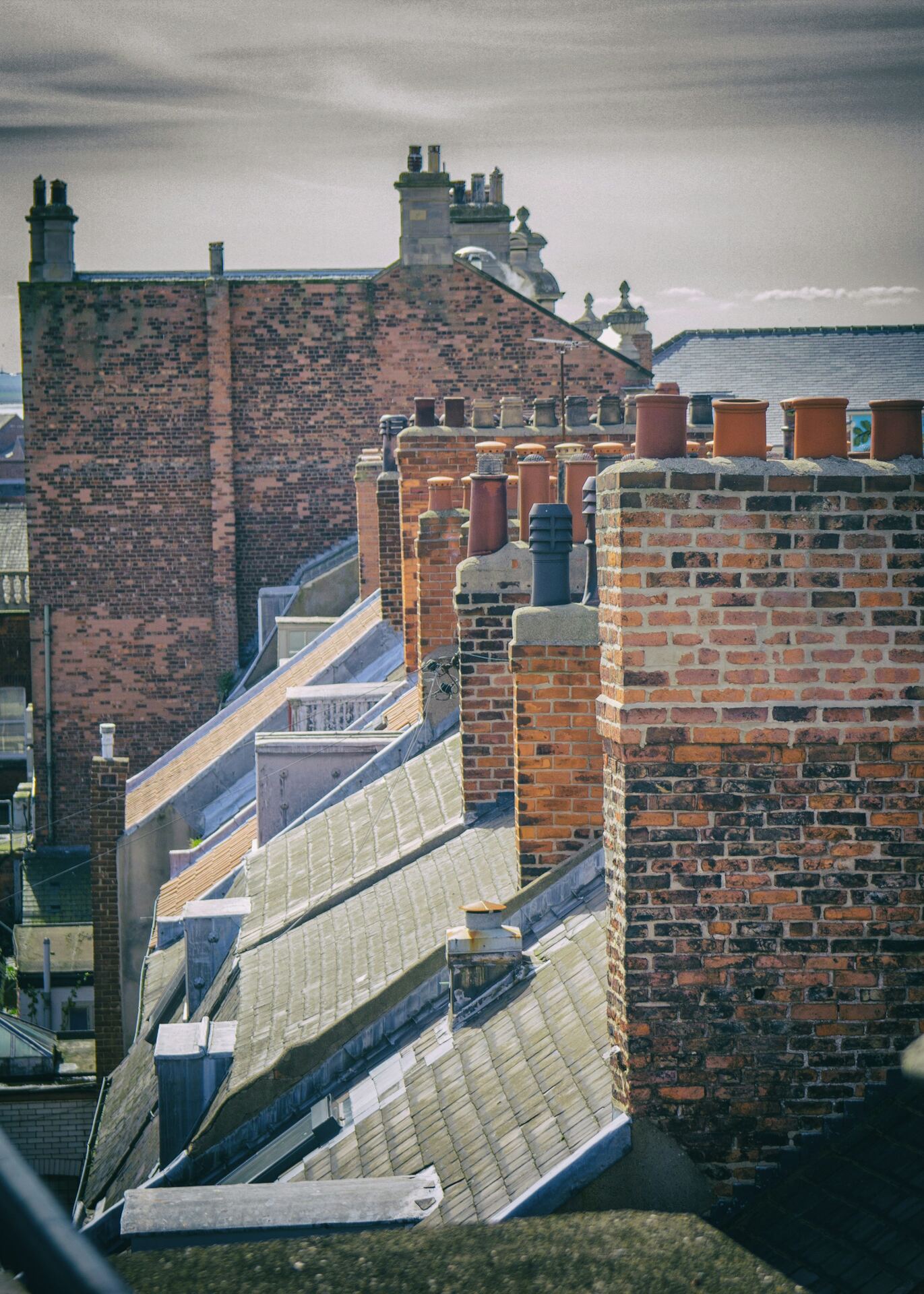
The building stone is local gritstone. The appraisal notes that stone quarried when Calverley Cutting was made through the wood went into most of the village’s late 19th-century terraces. Roofs are pitched at roughly 35–45 degrees, with full-height gables, and chimneys are a prominent feature on almost every house. That mix of heavy stone, steep pitches and plenty of stacks shapes most roof repairs here. Every job starts with a free survey and a fixed price in writing.
Stone slate and Welsh slate repairs
The appraisal says the roofs of Calverley’s early buildings are generally stone “slates”, while later buildings use dark Welsh slate. It is unusually clear that clay roof tiles are never used, and that synthetic roofing materials are not in keeping with the conservation area.
Stone slate is thick and heavy, hung on pegs or nails over battens. As the fixings rot or rust through, slates slip. A good repair lifts the affected courses, sorts out sound slates for re-use, makes up any shortfall with matching second-hand stone, and re-lays the courses in the original order. Welsh slate roofs on the later terraces tend to fail through ‘nail sickness’, worn ridges and cracked valleys. Where a whole slope has gone, we strip it, re-felt, re-batten and re-slate, re-using as much of the original as we can.
Swapping coverings needs care. Planning Portal guidance says building regulations approval is needed if a new covering is 15 per cent or more heavier than the old one, which is worth checking before a Welsh slate roof is ever re-covered in stone. See our slate and tile roofing page.
The Calverley Conservation Area
Calverley was first designated a conservation area on 15 February 1984. Leeds City Council revised the boundary on 9 April 2009, adopting the Calverley Conservation Area Appraisal and Management Plan the same day. The new boundary follows four character areas: the historic core, the late 19th-century expansion, the historic field pattern north of Carr Road, and Calverley Woods.
For the historic core, the appraisal lists keeping stone slate roofs and chimneys as a key way to retain its character. For the late 19th-century terraces it asks for stone or slate roofs and chimneys to be kept. Calverley Old Hall, partly 14th century and listed Grade I, was owned by the Landmark Trust when the appraisal was written.
Planning & permissions
Before any roof work inside the boundary
Like for like — the management plan names replacing roofing with inappropriate materials as a loss to the village, and says it is most noticeable on vernacular buildings and terraced rows. Stone slate for stone slate and Welsh slate for Welsh slate is the safe course.
Rear dormers — the council lists rear dormer windows among works that need planning permission in a conservation area.
Listed buildings — St Wilfrid’s Church, Calverley Old Hall and 1 & 3 Church House (Grade II*) are among the listed buildings. Changing a listed roof needs listed building consent.
Protected trees — Calverley Wood is ancient woodland covered by a Tree Preservation Order, as are the trees along Calverley Cutting and Clara Drive. Elsewhere in the conservation area most tree work must be notified to the council six weeks ahead.
Calverley Bridge, down by the river, is a separate conservation area with its own boundary map. To check an address, use the council’s conservation area pages, and we’ll flag anything that may need consent at the survey.
Calverley homes and their roofs
Vernacular cottages
Small, low gritstone houses in the old core, laid out informally along lanes such as West End Road and The Wicket, some of them earlier than 1755. Roof work here is careful, small-scale and like for like.
Stone slate · coped gables · stone stacks
Weavers’ terraces
The grid of late 19th-century gritstone terraces south and west of the core, such as Capel Street and Woodhall Road, two or three storeys high, often with blocked taking-in doors. Woodland View is a three-storey example with a former loom-shop on the top floor.
Welsh slate · shared stacks · gutters on stone or iron brackets
Villas & woodland houses
Houses built for Bradford industrialists and professionals, including the late 19th-century villas on Shell Lane, Arts and Crafts Grey Gables, and large houses set back from the tree-lined drives through Calverley Wood.
Stone slate or Welsh slate · hipped and gabled roofs · tall stacks
Chimney stacks on gritstone houses
With chimneys on almost every house, stack repairs are a regular part of looking after a Calverley roof. The appraisal records gritstone laid in fairly large, even courses and pointed in pale lime mortar. When that pointing washes out, water gets into the stack and down the chimney breast. We repoint in lime, renew lead flashings and soakers, re-bed pots and replace cracked flaunching. Where a stack is leaning or badly eroded, we take it down to sound stone and rebuild it to its original height and detail.
Starting prices are £350 for repointing, £450 for new lead flashing, £600 for a partial rebuild and £1,500 for a full rebuild, plus scaffolding from £400. What you actually pay depends on access and how the stack has weathered, and we fix it in writing once we’ve surveyed it for free. The chimney repair costs guide explains what moves those figures, and our chimney repairs page covers the work itself.
Gutters under Victoria Park’s trees
Calverley is a green village. The appraisal picks out the avenues of mature trees around Victoria Park, the tree-lined Chapel Street boundary, and the ancient woodland of Calverley Wood to the north. Leaves and twigs from all of them end up in gutters and outlets each autumn, and an overflowing gutter on a solid stone wall soon shows as damp inside. A clear-out after leaf fall, with joints, falls and downpipes checked at the same time, is a small job that heads off a much bigger one. See our guttering service.
Wind and weather on open ground
Being up on open farmland with long views over the valley also means Calverley roofs take the full force of a gale. Slipped stone slates are heavy and dangerous if they fall, so if you spot one on the ground or hanging at the eaves, keep people clear and call us. We take emergency callouts 7 days a week from Kirkstall (LS5), make the roof safe first, then quote in writing for the permanent repair. More on our emergency repairs page.
We cover Calverley streets including Town Gate, Blackett Street, West End Road, Thornhill Street, Carr Road, Chapel Street, Capel Street, Clarke Street, Rushton Street, Woodhall Road, Victoria Street, Shell Lane, The Wicket, Clara Drive, Eleanor Drive and the surrounding streets of LS28.
Inside the conservation area, it’s best avoided. Leeds City Council’s appraisal says early buildings have stone slate roofs, later ones Welsh slate, clay tiles are never used and synthetic materials are out of keeping. Its management plan treats inappropriate roofing materials as harmful. Re-using and matching stone slate is the safe route. We can price both at the survey.
No. Leeds City Council lists Calverley Bridge as a separate conservation area with its own boundary map. The Calverley Conservation Area covers the village: the historic core, the late 19th-century terraces, the fields north of Carr Road and Calverley Woods.
Trees along Calverley Cutting and Clara Drive, and Calverley Wood itself, are covered by a Tree Preservation Order, so cutting them back needs the council’s consent. We can repair the roof and clear the gutters, and tell you what the branches are doing to the roof so you can apply.
Prices start at £350 to repoint a stack and £450 for lead flashing; rebuilds start at £600 (partial) and £1,500 (full), and scaffolding from £400. Access and the state of the stonework set the final figure, which we confirm in writing after a free survey.
Slipped stone slate or a tired chimney in Calverley?
Free survey and a fixed written price, with a 10-year workmanship guarantee on major work.